Abstract
Surprisingly, little is written on scaling nonprofits. Overwhelmingly, much is written about scaling businesses. By any measure, it is not easy. We offer background on scaling, with particular attention to considerations, planning, and budgeting when scaling operations from the local to the landscape level. Broad success factors include clear leadership and planning, measuring standardized outcomes, and piloting successes that may not translate or replicate across other regions or landscapes. Recommendations for scaling at the project outset, including realistic cost estimates, are offered.
Takeaways
Tailoring strategies. Off-the-shelf solutions do not exist, especially in the forest health arena. However, bespoke solutions make scaling challenging, especially when they must be adjusted for each situation, geography, or organizational component. That takes time, which subsequently hinders scaling.
Pilots may not work. Sometimes called the “pilot and pray” approach, pilots are a good approach to test innovation at a smaller scale and with less investment. Nevertheless, we may be running out of time, funding, and resources to conduct pilots. If you have to pilot a project, try it at a small scale, with clear hypotheses and metrics set up to test effectiveness.
Measuring outcomes. Create monitoring and measurement systems that measure outcomes or impacts of forest health projects and your company’s success. See the Monitoring chapter for more details on creating a system to measure your business success.
Workforce. Finding qualified employees is a major challenge for the private and public sectors. Registered professional foresters (RPFs) are in short supply, and knowledgeable mill operators are difficult to find and train. Even assembling qualified thinning or prescribed fire crews led by experienced individuals can be difficult. Challenges are increased for nonprofits that offer lower salaries than the private sector.
Leadership. From an ownership perspective, company leadership can be tricky, e.g., letting go as the company founder when the business expands. Depending on organizational needs, leadership may be needed in different locations or at different times.
Background
Surprisingly, little is written on scaling nonprofits. Overwhelmingly, a lot is written on scaling businesses; much of it is breathless commentary about tech companies moving from a single founder to 1,000s of employees and how great the fireman’s pole at the SOMA office for [insert techy company name here] in San Francisco. Few to none of this oeuvre is linked to forest health, with most articles focused on scaling tech startups and most exploring the nuts and bolts of scaling.
Up/Out/Deep
In the conservation arena, Salafsky et al. (2021) adapted a framework that Moore et al. (2015) created for scaling conservation nonprofits. They identified three scaling approaches:
Scaling out involves replicating the initial pilot with three options: 1. expanding the scope, 2. replicating pilots within a program, and 3. promoting innovation diffusion by capturing and communicating what you’ve learned and getting other organizations to adopt your strategies.
Scaling up, e.g., policy change, takes a systems-level approach to leverage scale across a greater area rather than testing and replicating pilots.
Scaling deep is a behavioral change approach that changes the underlying values of the actors in a system. For example, it might involve building a stewardship ethic among landowners or creating and communicating stories that convey the needed values to key audiences. It’s best to take a careful, measured approach to scaling deep. In many cases, this type of strategy takes a lot of time and requires many touchpoints and well-thought-out plans to succeed.
Scaling out is common in conservation but has several downsides, including high risk and cost. Piloting may ultimately lead to what many conservation projects call the “pilot and pray” approach Salafsky & Margoluis, 2021. In other words, implementing conservation actions based on effectiveness while ignoring scalability risks Pienkowski et al., 2024. The bottom line is that we may often be beyond the pilot stage for forest or biodiversity conservation because wildfires, climate change, and habitat loss have advanced so far. Pienkowski et al. (2024) says the inverse can be true, e.g., promoting scalability over effectiveness, and that effectiveness can change with scale, possibly requiring different methods to measure outcomes. For example, voluntary carbon markets have failed to deliver benefits due to inadequate methods to measure additionality West et al., 2023.
Farmer-2-Farmer
Compared to agriculture, conservation falls far behind in understanding the factors related to adoption and scale. In his seminal book called Two Ears of Corn about farmer-to-farmer extension, Roland Bunch describes scaling agricultural extension by starting small and spreading through diffusion Bunch, 1982. A key component of this approach is small-scale experimentation. Farmers drive experimentation at this level on tiny, ~50 m2 plots, creating a low-risk approach to innovation. Small-scale experimentation also has several advantages at the programmatic level because it can reach the poorest farmers through low risk and low cost.
As more farmers run experiments and successful strategies emerge, the farmer-to-farmer program diffuses rapidly as farmers adopt cost-effective farming practices. The approach is self-sustaining and does not require technical assistance from outside experts, since farmers learn directly from one another; in other words, the program creates and turns its own flywheel Collins, 2005. Like the scaling deep approach mentioned above, farmer-to-farmer approaches can scale as movements and connect to social movements for food sovereignty Brescia, 2017.
Following the agricultural vein, Brescia (2017) offers a similar framework with the following categories: depth—groups of farmers innovate on their farms; breadth—horizontal scaling achieved when practices are spread across many farms and communities; and verticality—when practices are scaled across networks and movements, linking farmers to markets and supportive policies. Verticality is critical because it drives change by connecting to markets and policies.
Planned & Scaled Funding
Funding is an important scaling factor that the agricultural examples above don’t cover. In the scaling assumptions example, Salafsky et al. (2021) provides an excellent example of developing realistic budgets based on strategic plan goals and costing them out over time. They show that to reach a seemingly realistic but ambitious goal of 500,000 tons of CO2e sequestered, a hypothetical organization will have to carry out 250 projects over a decade. This is when s*%t gets real! The authors create a financial model to determine total projects, costs, tons of carbon sequestered, and cost/ton. The upfront work shows the value of testing assumptions before carrying out a plan Salafsky et al., 2021. A similar analysis could run in parallel, focusing on the staffing and workforce needed to carry out the plan. See the Mill Case dropdown below and Appendix 1 for a forest-based feasibility example.
Emotions
Molly Graham, drawing on her experience scaling at various tech companies, takes a unique approach, examining the people and emotional side of scaling. She notes that you should not try to avoid or ignore the emotions that come with the scaling tornado, but acknowledges that emotions are normal and that any other organization will go through similar circumstances Graham, 2024. She says that emotional acknowledgment, which she likens to making friends with the monster chewing on your leg, is only half the battle; the other half is how you respond (Figure 1).

Figure 1:Acknowledging and responding to the monster chewing on your leg is critical for managing scaling. Graphic credit: Graham, 2024.
Forest Businesses
Scaling businesses is a double-edged sword: while it is a well-trodden path with numerous success stories, the pressure to scale begins immediately, accompanied by expectations for profit and system-wide success. Factors business owners may want to consider when planning to scale include
Finance. As a business scales, different timelines, amounts, and items may arise, further complicated by market changes and other external factors. Financing from traditional institutions for new products and approaches may take longer to develop but should become easier as more forest health businesses come online with successful track records.
Funding. A funding mantra could be to use government grants to test and loans to scale. Government grants can help test new ideas, practices, and equipment and serve as a powerful innovation and test phase before scaling. After successful testing, loans can scale implementation across the landscape, building on the proven track record developed through agency grants. As highlighted in the Program Design chapter, use your business or strategic plan to prioritize the grants you pursue rather than allowing grant programs to change your priorities and vision.
Leadership/ownership. Company leadership can be tricky from an ownership/ideas perspective, e.g., letting go as the business expands. New leadership may be needed to manage satellite businesses and hire the right leadership to maintain corporate culture. Company founders may be used to overseeing all aspects of project and company development, so delegating those tasks and creating the structure to do it effectively becomes more critical as a company grows. As a company matures, succession becomes equally important and cannot be overlooked, especially during rapid growth. Similarly, over-dependence on the original leader/founder’s vision can hamper a company’s ability to scale and succeed beyond the original business bounds.
Markets. Many forest product markets are new, making them difficult to create. Creating a cooperative across multiple businesses to weather product startups may help, or entering new markets slowly, deliberately, and at small scales until they are established or you have consistent buyers. Another option is to diversify your product lines with a mix of traditional items to create a core revenue source and new products to test their selling power and viability.
Quality control. Maintaining quality control with franchises can be difficult, especially when the original product artisans can no longer oversee every aspect of production. Train new staff at satellite production facilities using the scaling procedure, and allow enough time to learn and get up to speed. Quality control can also be compromised when rapid production increases are required. Predicting how long this will take is exceptionally difficult, but it is worth considering several likely scenarios to prepare for future demands.
Maintenance. If you’re focused on forest health and restoration, build maintenance of previously treated sites into your scale model, considering workforce, transportation, equipment use, and distance to sites for processing wood. Maintaining equipment, vehicles, and other hardware depends on what you build into your costs, how you scale, and whether you have the right people to maintain equipment schedules.
Sustainability. How sustainable is your business as it expands? Do you have controls and principles in place to maintain sustainability? Creating and maintaining a focus on a triple bottom line, measuring your company’s performance based on profit, people, and planet (or environmental factors), building in B-corp certification, or giving back to the community can be significant factors. At another level, how do all of the factors in this section help your business weather change over time, and how do you measure sustainability or resilience to changes in supply, production, and markets?
Measuring outcomes. Create monitoring and measurement systems that measure the outcomes or impacts of forest health projects and your company’s success. See Chapter 4. Monitoring for a more detailed primer on monitoring.
Case Study: Scaling Test
Case
Testing your assumptions and feasibility for scaling is critical to long-term success and reaching your business or organizational vision/mission. Salafsky et al. (2021) offer an excellent and sobering example of scaling a carbon sequestration and wetland restoration project over time. We adapted their case study for a mill ramp-up scenario in Northern California. Detailed results from this analysis are provided in Appendix 1: Scaling Assumptions.
Stress Test
We stress-tested a scaling assumption of starting with a community-based mill that processes 1 MMBF/yr. The headline numbers: 3 MMBF/yr of lumber demands roughly 45,000 green tons/yr of small-diameter logs, which requires thinning 2,250 acres/yr; the program employs 54 FTE (36 at the mills, 18 in field thinning crews) at a payroll of $3.15M/yr, and needs $4.5M of installed mill capital. Because small-diameter thinning material is volume-hungry and labor-intensive, feedstock and staff together cost roughly three times the value of the commodity lumber the mills produce.
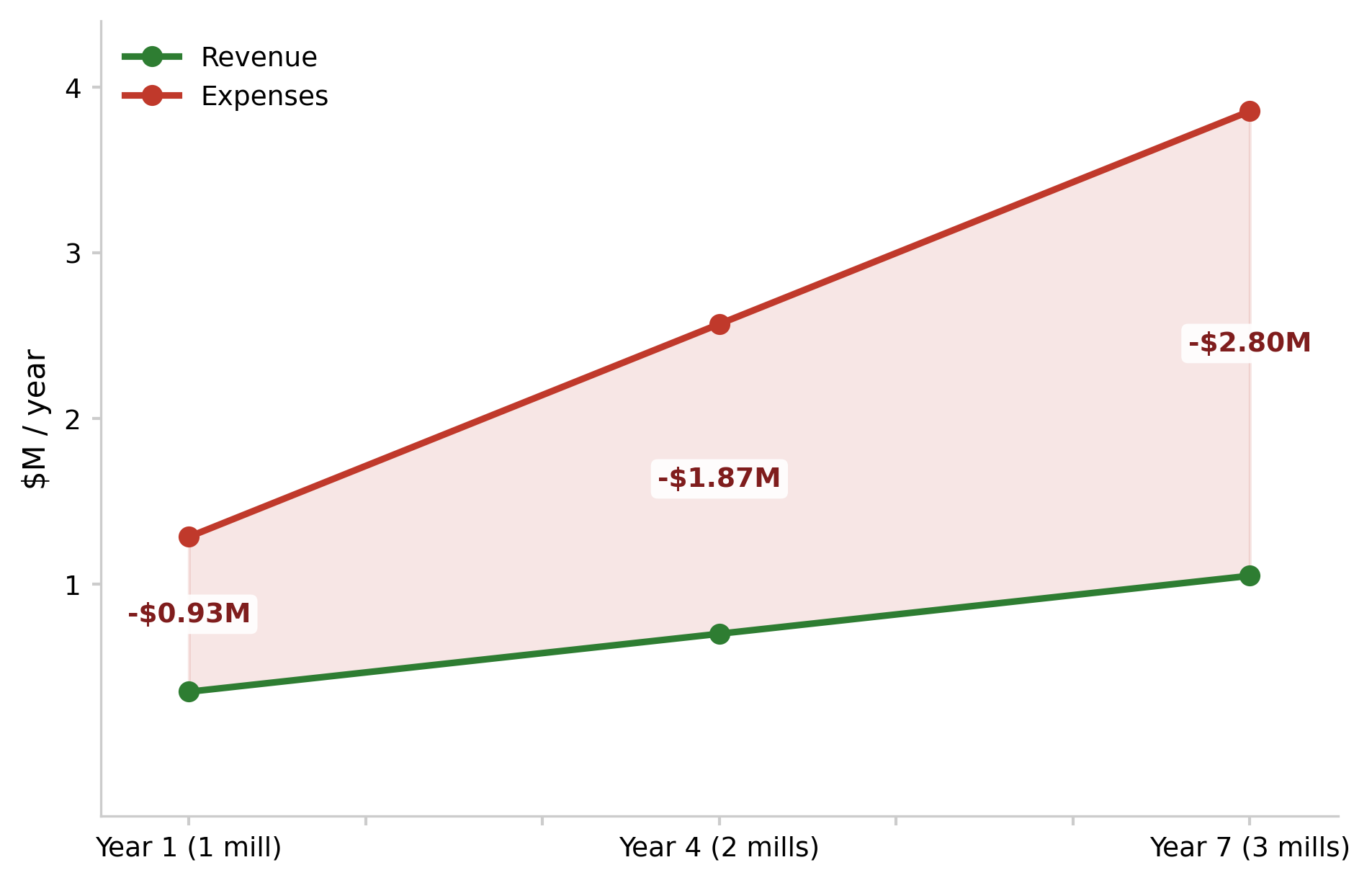
Figure 2:Revenue vs. operating expenses over program ramp-up.
Two scaling assumptions fail the stress test in ways that mirror the STAP wetland example. First, replication buys no capital economies of scale: three small mills carry the same $1.50 per board foot of installed capital as one, versus $0.67/BF for a single large industrial line. Second, revenue exceeds income Figure 2. The feedstock and staff base is far larger than intuition suggests: 15 green tons of logs are needed per MBF of lumber (vs. 3.8 tons/MBF for large-log industrial mills), and the payroll alone ($3.15M/yr) exceeds total lumber revenue ($1.05M/yr).
Challenges
Rapid scaling is a massive challenge, particularly for nonprofit organizations that often can’t scale quickly because of funding, workforce, and governance issues. These issues can feel overwhelming, but each piece is not insurmountable and often has simple solutions. Patterns of challenges for scaling include
Workforce. Finding qualified employees is a major challenge for the private and public sectors. RPFs are in short supply, and knowledgeable mill operators are difficult to find and train. Putting together qualified thinning or prescribed fire crews led by experienced individuals is challenging. Challenges are increased for nonprofits that offer lower salaries than the private sector.
Chicken and egg finance. Banks no longer have in-house experience or the due diligence needed to review loans for forest health and infrastructure projects. To compensate, they ask businesses to return once the business is functioning. This chicken-and-egg situation, akin to not being able to apply for a job out of college w/o experience, is trying for new businesses or existing businesses trialing new technologies. This challenge may decline over time, but it certainly doesn’t help accelerate the pace and scale of forest health treatments.
Funding & scale. Funders often ask for scalable projects but don’t provide the necessary funding to scale once a project is successful. Also, public investment through grants, which is fantastic for trialing new and innovative programs or equipment, is not being leveraged with private funding.
Nonprofits scaling pace. Nonprofits typically do not scale quickly. It’s impossible to scale when you fund many projects based on a reimbursable format, as is the case with most state and federal agency funding sources.
Agency agreements impede scale. Currently, the slow pace of executing agency agreements—some may take upwards of one year after grant awards—significantly impedes the pace and scale of forest health implementation. The cost and speed of environmental compliance are similar issues that slow project implementation.
NIMBY. Neighbors may oppose projects despite the need for biomass utilization, forest products, and mills. For example, Alpenglow Timber in Truckee, California, faced a NIMBY challenge in late 2024, even though some opponents were involved in forest or biomass projects elsewhere.
Project size ≠ need. Coordinating across multiple actors in a region can be particularly challenging and take a lot of time, time that some organizations do not have when starting new entities. For example, projects in the California Wildfire Task Force tracking dashboard may look small compared with the goal of treating one million acres statewide.
One size doesn’t fit all. This creates a conundrum that prevents scaling, since every effort to scale requires bespoke changes in policy, funding, workforce, behavior, and institutions Churches, 2023. Furthermore, some companies may be content to scale to a certain size; others may wish to grow further. The organization’s board can factor this right size into planning, but bottom-up ownership of this growth also needs attention, not just top-down direction from the board.
Effectiveness & scalability. Evidence of scaling effectiveness, readiness, and risk evaluation can be lacking in projects. Total impact depends on more than scalability; it is the sum of effectiveness and scale Pienkowski et al., 2024.
Recommendations
Considerations to incorporate scale when developing your business, project, and programs for forest health include the following:
Consider scale from the outset. Consider scaling from the start of your program design.
Calculate scale costs. Rough out the costs of scaling your work and assess feasibility.
Transform emotional scale. Be aware of the emotional cost of scale to you as a business owner or nonprofit manager and its impact on your staff.
Carefully consider replication & adoption. Replication and adoption are moving targets and change as you scale.
Measure success. Measuring success gets more complicated at scale, but it becomes infinitely more valuable for learning and determining what is working and what isn’t.
- Salafsky, N., Suresh, V., Bierbaum, R., Clarke, E., Smith, M., Whaley, C., & Margoluis, R. (2021). Taking Nature-Based Solutions Programs to Scale. FOS, STAP, GBMF. https://stapgef.org/sites/default/files/2021-06/Taking%20Nature%20Based%20Solutions%20to%20Scale%202021-01.pdf
- Moore, M.-L., Riddell, D., & Vocisano, D. (2015). Scaling out, scaling up, scaling deep: strategies of non-profits in advancing systemic social innovation. Journal of Corporate Citizenship, 58, 67–84. 10.9774/GLEAF.4700.2015.ju.00009
- Salafsky, N., & Margoluis, R. (2021). Pathways to success: Taking conservation to scale in complex systems. Island Press.
- Pienkowski, T., Jagadish, A., Battista, W., Blaise, G. C., Christie, A. P., Clark, M., Emenyu, A. P., Joglekar, A., Nielsen, K. S., Powell, T., & others. (2024). Five lessons for avoiding failure when scaling in conservation. Nature Ecology & Evolution, 1–11. 10.1038/s41559-024-02507-4
- West, T. A., Wunder, S., Sills, E. O., Börner, J., Rifai, S. W., Neidermeier, A. N., Frey, G. P., & Kontoleon, A. (2023). Action needed to make carbon offsets from forest conservation work for climate change mitigation. Science, 381(6660), 873–877. 10.1126/science.ade3535
- Bunch, R. (1982). Two ears of corn. A guide to people-centered agricultural improvement. World Neighbors.
- Collins, J. (2005). Good to great and the social sectors: Why business thinking is not the answer.
- Brescia, S. (2017). Fertile ground: Scaling agroecology from the ground up. Food First.
- Graham, M. (2024). Make friends with the monster chewing on your leg, and other tips for surviving startups. Firstround. https://review.firstround.com/make-friends-with-the-monster-chewing-on-your-leg-and-other-tips-for-surviving-startups
- Churches, K. (2023). The Nonprofit World Is Obsessed With Scaling. But Is It Always the Right Choice? The Chronicle of Philanthropy. https://www.philanthropy.com/article/the-nonprofit-world-is-obsessed-with-scaling-but-is-it-always-the-right-choice