Abstract
California’s forests are fire-adapted systems operating far outside their ecological carrying capacity due to a century of fire suppression compounded by climate change. Ecological forest health treatments, including thinning and prescribed fire, are needed to restore forests. Biomass utilization is a downstream necessity of forest health treatments to reduce wildfire risk to communities and the natural world. Although biomass plants emit and affect air quality, uncontrolled wildfires produce far larger, more damaging emissions and public health impacts. Misinformation about biomass and forest health leads to misdiagnosis of wildfire risk to natural and human systems and policy failure. Confronting these compounding risks requires moving beyond divisive debates and toward science-based action. We propose constructive, integrated solutions to implement at scale that encompass the entire process to achieve healthy, resilient forests, create jobs, and protect biodiversity.
Takeaways
Fire-adapted forests are experiencing widespread stress, mortality, and megafires as a result of a century of fire suppression. Suppression has led to excessive fuel buildup and unnaturally dense forests, with too many trees competing for limited water and nutrients.
Biomass utilization is an integrated downstream component of forest health treatments.
Continued business as usual will mean that California’s forests continue being a net emitter of carbon. Biomass utilization is not free of greenhouse gas emissions; however, it is part of a broader strategy to greatly reduce massive emissions from uncontrolled wildfires.
The economics of biomass utilization are not about subsidizing energy production. They aim to reduce catastrophic losses, stabilize long-term risk, and capture value from material streams generated by forest restoration.
Policies that focus on reducing emissions from biomass while integrating forest health solutions with climate change are critical to the long-term biodiversity and human health throughout California and the West.
Background
Recently, CalMatters published a commentary by Shaye Wolf of the Center for Biological Diversity, claiming that biomass is a money pit that won’t solve California’s energy or wildfire problems Wolf, 2025. The piece cited research by authors whose work has been widely challenged by climate and forest scientists, and made several unsupported or inaccurate assertions. Shortly afterward, Matt Dias, California Forestry Association, responded, arguing that biomass utilization is not primarily about renewable energy production, but confronting the wildfire crisis created by a century of fire suppression Dias, 2025.
We believe the debate cannot be understood through a narrow energy lens alone. A durable response to California’s forest and fire crises requires restoring forest conditions that can function under current and future climate realities. That includes re-establishing fire regimes that combine active intervention with nuanced maintenance approaches appropriate to the system. In the short and medium term, this will require ecologically informed removal of excess trees and underbrush, along with responsible management of the byproducts generated by those treatments. The goal is not extraction, but restoring balance and ecological function through cultural burning, intentional fire, and selective, place-based forestry practices.
All living species interact with their environments in order to survive; humans are no different. People have actively engaged with California’s forests using fire since these ecosystems emerged at the end of the last ice age. The question, then, is not whether humans can or should be involved in living systems, but whether that involvement is wise, adaptive, proportional, or destructive. Indigenous stewardship offers an essential reference point here, grounded in practices that combine active intervention with clear guidance on when, where, and how to apply fire, and when to step back. It is the breakdown of those relationships, not human presence itself, that lies at the root of today’s forest and wildfire crisis.
This article examines the need for forest health treatments that produce biomass and addresses common myths about their use in fire-adapted forests.[1] It then situates the biomass debate within broader patterns of wildfire disinformation, explores impacts on biodiversity, and outlines integrated solutions for restoring forest resilience.
Biomass
Debates over biomass are often framed narrowly, as disputes over energy technology or emissions accounting. In practice, many critiques of biomass draw on broader misunderstandings about wildfire, forest structure, and the role of human intervention in fire-adapted landscapes. Claims such as “fires are mostly a shrubland problem,” “thinning increases fire severity,” or “forests should be left alone” shape public perception long before questions of biomass utilization are considered.
When these assumptions go unexamined, biomass becomes a proxy target for deeper anxieties about forest management. The result is a familiar pattern: misunderstood fire ecology leads to misdiagnosed forest conditions, which in turn produce a misframed biomass debate and, ultimately, policies that fail to reduce wildfire risk. This sequence does little to address the underlying drivers of large, high-severity fires in the western United States and obscures the material realities created by necessary forest restoration.
THE disagreement
In reality, the debate isn’t really about biomass. It’s about whether active forest management is ecologically legitimate under novel climatic conditions. The Center’s position implicitly says restraint and retreat are the answer; our position is that intervention, done carefully, is unavoidable. Surfacing that philosophical split would make the argument clearer and more honest.
Forest residuals
Biomass utilization is a critical downstream process of forest health treatments. It is not a driver of logging. In mitigating wildfire, we need to make the distinction between 1. sawtimber, 2. unavoidable treatment residues, and 3. Excess forest biomass or residual streams exist whether or not there’s an energy market. We also need to make it clear that sawtimber, clearcutting, or excessive forest harvesting cannot be conflated with forest health or wildfire mitigation.
Burning & air quality
We acknowledge that older biomass plants were dirty, but modern regulations, controls, and siting are helping to mitigate that issue. These and environmental justice impacts from siting facilities in disadvantaged communities can and should be further strengthened with strong CEQA and other environmental policies. Nevertheless, poor air quality and greenhouse gas emissions from wildfires dwarf regulated point sources. The nearly million-acre Dixie fire, California’s second-largest wildfire, emitted 37 million tonnes of CO2e or the equivalent emissions from electricity consumption of nearly 5 million households Baldassare, 2024. In 2020, wildfires emitted 127 million tons of CO2e, nearly twice California’s total greenhouse gas emissions reductions achieved since 2003 Jerrett et al., 2022.
Wolf suggests leaving biomass residues in the forest. Masticating on site, lopping and pilling, or removing residue to landings has long been practiced at thinning sites. But the accumulation of materials is overwhelming. A study showed that there are approximately 150,000 acres of piles representing 1,000,000 tons, with 78% of these materials on public lands Darlington et al., 2023.[2] Even disposing of those piles by burning is an episodic, unregulated process that would be much more harmful than utilization in long-term wood products or burning at a facility.
Energy vs. material flow
We need to separate “biomass as energy” from “biomass as material-flow management.” Wolf collapses everything into burning trees for electricity. Biomass utilization is neither an energy silver bullet nor an unending consumer of timber and spewer of wood smoke from giant burning plants. Rather, it is one of several tools for addressing California’s wildfire crisis, which itself is the result of a century of fire suppression that has produced unnaturally dense, stressed forests increasingly vulnerable to disease, drought, and high-severity fire under a warming climate.
The broader challenge is not energy production per se, but system efficiency: how to handle the unavoidable forest residues generated by necessary forest health treatments. From that perspective, biomass utilization is best understood as part of a landscape-scale risk-reduction and materials-management strategy, spanning multiple uses including long-lived wood products, combined heat and power, thermal energy, and biochar.
One useful way to think about this is as a full-circle wood economy (Figure 1), in which forest biomass flows into three broad pathways: burn, bury, or build. Burn includes both open-pile burning and energy generation; bury includes decomposition, landfilling, or unmanaged decay; and build includes integrating wood-based carbon into longer-lived material uses, such as mass timber, engineered wood products, biochar, and soil amendments that store carbon for decades or even centuries while displacing more emissions-intensive materials.
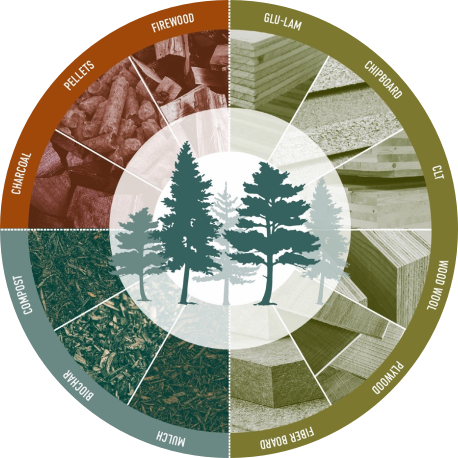
Figure 1:Products from ecologically managed forests. Burn (red, upper left) = in fire-prone forests, using wood to power low-emission bioenergy facilities replaces fossil fuels and produces less GHGs than pile burning or mega fires. Bury (green, lower left) = compost is one of the simplest products made from any woody biomass, requiring little energy and diverting biomass from landfills (where it can generate methane, a greenhouse gas). Build (brown/green, lower right) = making productive use of harvested wood is difficult due to a lack of processing infrastructure. More distributed solutions for utilizing small-diameter wood for building material should be pursued to create a viable economy for ecological forest management.
Seen this way, the policy question is not whether biomass exists; it does. The question is whether we design systems that treat it as a resource whose fate can be shaped deliberately. The system question could reflect nature, e.g., maximizing the system efficiency by finding uses for every element in the residue equation. This includes both utilization and leaving in place.
Economics
At the statewide scale, cost–benefit analyses illustrate both the magnitude of the problem and the opportunity. As shown in Figure 2, reaching California’s current goal of treating one million acres per year requires substantial investment, but the estimated benefits already exceed costs by a wide margin Brown, 2024. At treatment levels closer to what is required to meaningfully reduce wildfire risk after a century of fire suppression, net benefits increase further. Whereas these dollar values may appear large, they reflect the true scale of avoided suppression costs, reduced disaster losses, and long-term risk stabilization in a state where wildfire has become one of the most expensive unmanaged liabilities.
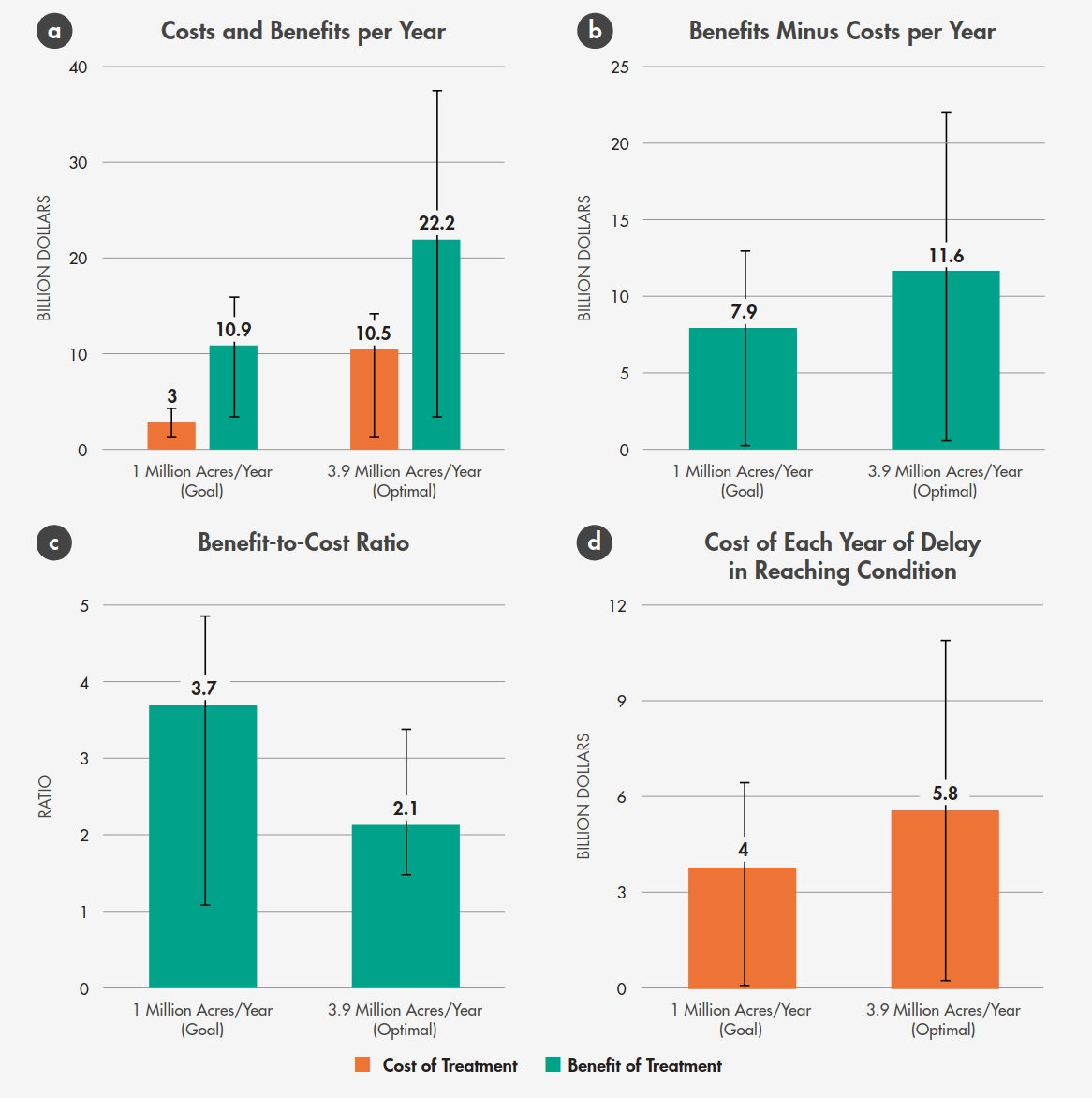
Figure 2:Costs/benefits of California fuel reduction at the goal of 1 million acres vs. 3.9 million acres—the rate that maximizes net benefits Brown, 2024.
Additional studies reinforce this conclusion; estimating returns on investment of more than three dollars for every dollar spent on fuel treatments and benefit–cost ratios approaching four when avoided damages are included Strabo et al., 2025Turner, 2023. The economic question, then, is no longer whether California can afford to treat its forests, but whether it can afford not to.[3]
Large-scale forest treatments inevitably generate substantial volumes of woody material. From an economic standpoint, this material is not optional; it is an unavoidable byproduct of necessary restoration. If it is left in place, piled, or masticated, wildfire risk is often shifted rather than reduced, and carbon is released through decay or open burning without benefit. That biomass must go somewhere. Deliberate utilization converts an unavoidable cost into a managed material flow that supports risk reduction rather than undermining it.
Another longer-term economic value is often undercounted: carbon storage and avoided emissions. Using forest biomass in longer-lived products such as mass timber, engineered wood, or biochar effectively sequesters carbon that would otherwise be released through wildfire or decomposition, while simultaneously displacing more emissions-intensive materials. Modeling studies show that treated forest scenarios can result in greater total carbon storage over time despite substantially lower tree densities, due to reduced wildfire emissions and increased growth of large trees Elias et al., 2025Delyser et al., 2025.
Taken together, the economics of biomass utilization are not about subsidizing energy production. They are about reducing catastrophic losses, stabilizing long-term risk, and capturing value from material streams generated by forest restoration. In this context, biomass utilization functions less as a cost center and more as preventive infrastructure—an investment that lowers future public expenditures while supporting more resilient forests, communities, and regional economies.
BIOMASS FAQs
In addition to wildfire and climate disinformation, several recurring claims about biomass utilization appear frequently in public debate. These arguments often rely on incomplete framing, and their resolutions benefit from clarification and nuance.
Biomass is not a downstream process. A common claim is that thinned biomass should simply be left in the forest rather than removed or utilized. In practice, leaving large volumes of treated material in place can suppress understory regeneration and, in some cases, increase fire risk. In extreme scenarios, residual piles or log decks have contributed to fire spread. The 2021 Dixie Fire, which burned more than one million acres across the Plumas National Forest, is widely acknowledged to have spread in part through a log deck and thinned fuel piles left on site after forest operations. At the scale now required for restoration, residual material must be actively managed rather than assumed to be benign.
Carbon accounting is context dependent. Biomass utilization is not zero carbon, even with modern technologies that reduce emissions. However, in fire-prone forests, the relevant comparison is not biomass versus no emissions, but biomass versus uncontrolled wildfire and decay. Large wildfires release immense amounts of carbon rapidly and unpredictably, often exposing downwind communities to smoke for weeks or months. Due to repeated high-severity fires, California’s forests have been a net source of carbon emissions since 2015 Delyser et al., 2025. Leaving biomass from thinning projects in place does not eliminate emissions and can shift wildfire risk or create unnatural conditions from excessive wood chips on the forest floor. Carbon accounting must also include sequestration. In treated forests, large trees grow larger, and total carbon storage can increase over time. A recent simulation found that treated forest scenarios retained 6% more carbon despite a 74% reduction in trees per acre Elias et al., 2025.
Concerns about “feeding the beast” are geographic. Opponents of biomass utilization often raise concerns about creating demand that incentivizes harvesting from intact or old-growth forests, citing examples from the southeastern United States or Europe Frisch & Uden, 2022. Those concerns deserve scrutiny, but they do not translate directly to the American West. In California and much of the western United States, biomass associated with utilization proposals overwhelmingly comes from wildfire mitigation and forest health treatments. Approximately ninety percent of forest land is publicly owned or held by small private landowners, and large-scale industrial clearcutting for biomass is neither the dominant practice nor the policy goal.
Biomass is not an energy silver bullet. Biomass energy is not intended to replace renewable energy sources such as solar or wind. Its role is local and complementary, focused on managing unavoidable material streams produced by forest restoration. Compared with open pile burning or uncontrolled wildfire, regulated utilization can be less polluting and more predictable. The central issue is not biomass versus other renewables, but how California addresses its wildfire emergency while managing the material consequences of necessary forest treatments Dias, 2025.
Policy incentives shape outcomes, not extraction. Programs such as the Bioenergy Market Adjusting Tariff Program, or BIOMAT, required utilities to purchase power from small, local facilities that convert forest biomass to energy. The program was designed to support material processing capacity near treatment areas, not to drive increased harvesting. With the program’s expiration, facilities capable of handling biomass from forest health projects have idled or closed. Creating a successor program that enables appropriately sited facilities to operate, or re-idle facilities such as Loyalton, is critical to ensuring that biomass generated through restoration can be processed responsibly rather than disposed of through open burning or left to accumulate on the landscape.
Wildfire disinformation
As with climate change, misinformation about wildfire, forests, and logging has increasingly shaped public understanding and policy debates Jones et al., 2022. In California, this misinformation is often reinforced by deeply ingrained visual and cultural assumptions about what a healthy forest looks like. Many people implicitly picture dense, closed-canopy forests modeled on the eastern United States, northern Europe, or England, landscapes that evolved under very different climatic and ecological conditions.
California’s forests exist largely within a Mediterranean climate, characterized by wet winters and long, hot, dry summers. These conditions favor fire-adapted ecosystems rather than the dense, moisture-rich forests common in temperate eastern regions. When forest health is judged using the wrong ecological reference point, fire-adapted landscapes can be misdiagnosed as degraded or overmanaged, while overly dense stands are mistakenly viewed as natural or desirable.
These misconceptions shape how wildfire risk is interpreted and how solutions are evaluated. Simplified narratives, such as the claim that destructive fires are primarily a shrubland phenomenon, further obscure the reality that California’s most damaging fires occur across mixed landscapes that include forests, shrublands, and the wildland–urban interface. When wildfire ecology is misunderstood in this way, forest management and biomass utilization are often framed as unnecessary or harmful rather than as responses to a misaligned, historically altered system.
Wildfire disinformation matters not only because it is inaccurate and undermines accepted science, but because it drives policy choices that fail to address the underlying causes of high-severity fire in a fire-adapted landscape Cook, 2020.
Fire-adapted forests & cultural fire
A growing body of ecological research, supported by historical records and Indigenous knowledge, makes clear that most of California’s landscapes burned regularly prior to Euro-American settlement. From the coast to the Sierra Nevada and beyond, fire occurred on highly variable but frequent cycles, often on the order of five to fifteen years, depending on vegetation type, elevation, and local climate. Fire was not an anomaly in these systems; it was essential to their function (Figure 3).
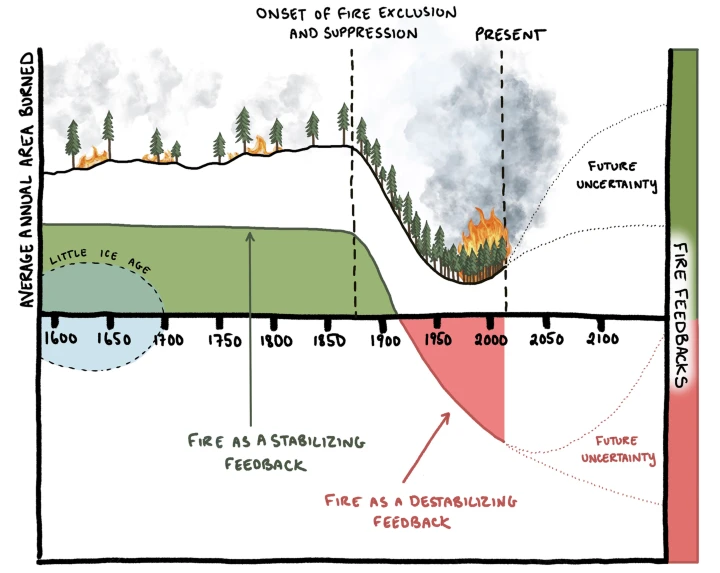
Figure 3:Conceptual figure illustrates the impacts of fire exclusion and suppression on area burned and fire severity in historically frequent-fire North American forests and woodlands represented by the majority of the fire scar sites used in the analysis by Parks et al. (2025).
Indigenous peoples actively shaped these fire regimes through intentional burning, now commonly referred to as cultural burning. These practices did not simply mimic lightning ignitions but actively guided fire to support food systems, medicinal plants, wildlife habitat, travel corridors, and sacred landscapes. Cultural burning worked in concert with natural fire to sustain open, patchy forests, interspersed meadows, and diverse age structures, supporting high levels of biodiversity and resilience.
Decades of fire science align closely with this knowledge. Prior to widespread fire suppression, western forests tended to have larger trees, lower overall density, and greater structural heterogeneity North et al., 2009Stephens et al., 2007. The removal of frequent, low- to moderate-severity fire disrupted these systems, allowing fuels to accumulate and forest structure to shift far beyond historical and ecological norms.
Fire suppression
The transition from frequent, smaller fires to the large, high-severity wildfires of today is not a natural evolution but the result of more than a century of fire suppression Collins et al., 2017Peery et al., 2019. Historically, regular fire functioned as an active form of landscape management. It improved tree health by reducing competition, clearing understory fuels, removing dead or weakened vegetation, and opening the forest canopy to sunlight. These processes reduced water stress, improved nutrient cycling, and supported the development of meadows and open patches that acted as natural fire breaks.
Frequent fire also interacts with hydrology. By reducing excessive tree density, fire helped balance water demand with available moisture, supporting smaller, localized water cycles and maintaining soil and vegetation health. In these landscapes, most fires burned at lower intensity and often self-extinguished as they encountered patchy fuels and open areas. Large, stand-replacing fires were relatively rare.
Fire suppression reversed these dynamics. Forests became denser and more uniform, fuels accumulated continuously across large areas, and the patchiness that once limited fire spread was lost. Under modern climate conditions, this produced fires that burn hotter, spread farther, and cause far greater ecological and social damage than the frequent fires they replaced.
Restoring fire-adapted landscapes, therefore, requires reintroducing fire as a management tool, alongside thinning and other treatments that help re-establish appropriate structure. In the near term, this process generates large volumes of forest residuals. Biomass utilization does not drive this work; rather, it emerges from it as a practical necessity. Over time, as landscapes regain balance and fire resumes its ecological role, the need for intensive intervention and large-scale biomass handling can and should decline.
Biodiversity
It is well known that indigenous burning, as part of historic fire regimes, enhanced biodiversity Hoffman et al., 2021. Additional evidence indicates that a combination of thinning and prescribed fire significantly increases plant diversity in mixed or dry conifer forests Dodson et al., 2008. However, California is very diverse, and what works in one ecosystem may not work in others, especially in chaparral or mesic systems, where burn frequency is generally too high and thinning or prescribed fire are not applicable treatments. However, in fire-adapted systems, biodiversity is inextricably linked to pyrodiversity Fernando & McCarthy, 2025.
Solutions
Returning to the mantra burn, bury, build, we recommend that all biomass utilization solutions incorporate the highest and best uses of forest product pathways (Figure 1). Moving forward, several integrated pathways can support forest health and biomass utilization:
Climate adaptation and biomass integration. Rapid scaling of forest health treatments, including thinning and prescribed fire, is critical to maintaining forest resilience in a warming climate Delyser et al., 2025. Policies that align forest treatments, biomass utilization, climate goals, and greenhouse gas reduction can reduce wildfire risk while ensuring that utilization infrastructure supports, rather than distorts, restoration outcomes.
Right-sized processing technologies. Biomass infrastructure should be flexible and place-based, reflecting the temporary nature of excess fuels created by past fire suppression. Avoiding permanent, oversized facilities reduces the risk of creating demand disconnected from ecological need. Modular and mobile systems can prioritize local utilization, reduce transport emissions, and adapt over time as landscapes recover. However, scaling these systems has proven difficult due to economic, permitting, and seasonal challenges.[4]
Proactive disaster insurance and risk pricing. Repeated large-scale wildfires threaten to make entire regions uninsurable and, eventually, uninhabitable. Aligning insurance markets with forest treatment incentives can reduce losses, stabilize premiums, and lower long-term public costs Harrison, 2025. Disaster response should not form the basis of a growth economy. Instead, policy and market mechanisms can reward risk reduction and penalize continued inaction.
Jobs in the woods and community resilience. Forest restoration and biomass utilization can create meaningful, long-term employment in rural and fire-prone communities that have experienced decades of economic decline and capacity loss. Investing in local stewardship workforces supports both ecological restoration and social resilience, while helping to reverse patterns of outmigration and disinvestment.
Biodiversity as a guiding constraint. Biodiversity is not an argument for or against biomass utilization, but it must remain a central constraint on the design and implementation of forest health treatments. Ecological forestry that creates gaps, clumps, and heterogeneity supports habitat diversity, while indiscriminate thinning or the removal of all snags can undermine ecological goals. Restoration strategies must remain ecosystem-specific and adaptive, recognizing that approaches suitable for dry conifer forests may not apply in chaparral or mesic systems.
Conclusion
Taken together, these pathways point toward a future in which California’s forests are once again shaped by frequent, beneficial fire rather than catastrophic megafires. Biomass utilization plays a supporting role in this transition, helping to manage the legacy of fire suppression while landscapes are brought back into balance. The long-term goal is not perpetual intervention, but the restoration of living systems capable of sustaining themselves through wise, adaptive stewardship.
California’s wildfire crisis is not the result of too much intervention, but of too little, applied too late, across landscapes that evolved to burn regularly. A century of fire suppression has pushed forests far beyond their ecological carrying capacity, producing dense, fuel-loaded systems that are increasingly vulnerable to drought, disease, and high-severity fire. Addressing this reality requires moving beyond narrow debates about individual tools and toward a whole-systems approach grounded in fire ecology, climate adaptation, and long-term stewardship.
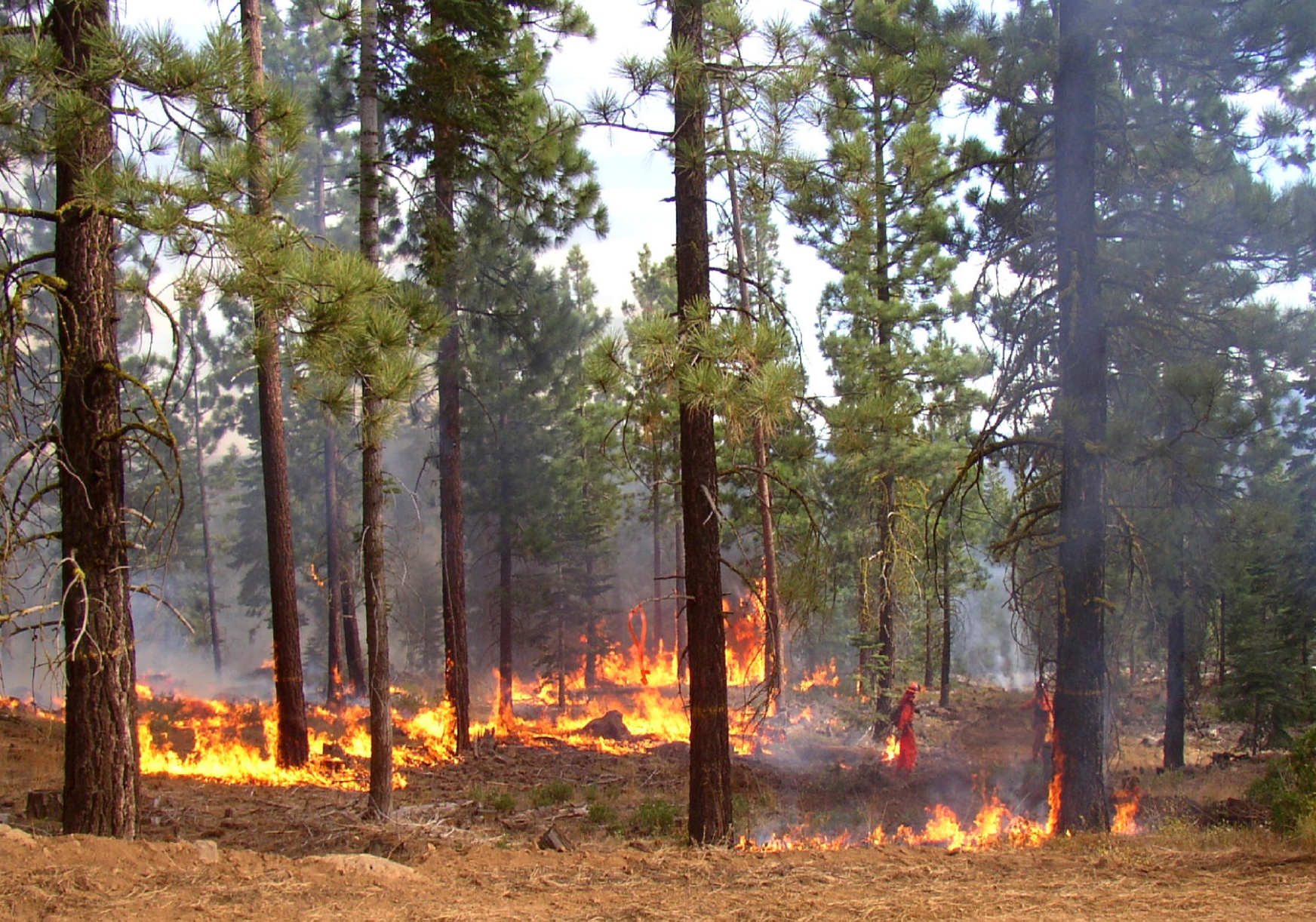
The choice facing California is not between profit and responsibility, but between managed transition and unmanaged failure Harrison, 2025. Restoring fire-adapted forests means reintroducing frequent, low-intensity fire and rebuilding structural diversity at scale. In the near term, this inevitably requires thinning and other treatments that reduce competition, improve tree health, and lower fire severity. These actions, when followed by prescribed fire, have been shown to reduce wildfire risk, limit stand-replacing fire, and increase forest resilience under extreme conditions, as demonstrated in recent fires such as the Caldor Fire, where prior prescribed burning helped deflect fire behavior and protect surrounding landscapes North et al., 2022.
Crucially, this restoration work produces large volumes of forest residuals. Biomass utilization does not justify forest intervention, nor does it replace the long-term role of fire. It functions as a transitional tool that helps manage the material consequences of restoring fire-adapted systems while forests move back toward conditions where cultural burning and good fire can once again do most of the work.
Authors
Vance Russell has nearly 40 years of experience working in forest science & management, rewilding, biodiversity conservation, agricultural landscapes, restoration, and natural resources management. He is the owner of 3point.xyz, where he works for various non-profit, state/federal agencies, and private businesses. Vance is the former Board Chair of Groundswell International, is a trustee for the South Downs National Park Trust, and serves on the Rewilding Leadership Council for the Rewilding Institute.
Joshua Harrison is Director of the Center for the Study of the Force Majeure at the University of California, Santa Cruz, where he leads interdisciplinary teams designing regenerative systems in response to climate disruption. His work bridges art, science, and policy: from immersive installations on ocean collapse to circular-economy models for wildfire-damaged forests and allyship with tribal groups bringing back cultural burning.
The broad application of treatments across regions and ecosystems is inappropriate and can further degrade stressed ecosystems. What works in Northern California (thinning/prescribed fire) is not the same as what works in Southern California (ignition prevention, structural hardening, strategic fuel breaks) O'Connell, 2025. For example, mechanical removal of chaparral can lead to weed invasion, thereby increasing fire risk Keeley, 2002Syphard et al., 2018.
Only 19% of this material is accessible via existing road networks.
When we subsidize supply, biomass is a waste product. When we subsidize demand, biomass is a value proposition. (Clarke Stevenson, personal communication, 2026)
Wider adoption and scaling of mobile and modular biomass processing technologies have been limited due to a number of challenges: Deployment economics, economies of scale, availability and suitability of processing sites, permitting and administration of multiple sites, seasonality and operational accessibility, and managing limited operating seasons such as wildfire danger and listed species constraints (Larry Swan, personal communication 2026).
- Wolf, S. (2025). Biomass is a money pit that won’t solve California’s energy or wildfire problems. Calmatters. https://calmatters.org/commentary/2025/12/biomass-california-energy-wildfire-problems
- Dias, M. (2025). California is drowning in hazardous forest waste with nowhere to put it. Calmatters. https://calmatters.org/commentary/reader-reactions/2025/12/hazardous-forest-waste-wildfire-california
- Baldassare, D. (2024). North Fork Forest Recovery Project Carbon Effects Report.
- Jerrett, M., Jina, A. S., & Marlier, M. E. (2022). Up in smoke: California’s greenhouse gas reductions could be wiped out by 2020 wildfires. Environmental Pollution, 310.
- Darlington, C., Moghaddas, Jason, & Fanslow, G. (2023). California forest biomass pile data collection. Joint Institute for Wood Products Innovation. https://cdnverify.bof.fire.ca.gov/media/fbplcgwm/california-forest-biomass-pile-data-collection_adamfk.pdf
- Brown, P. (2024). Cost-effectiveness of large-scale fuel reduction for wildfire mitigation in California. JSTOR. https://www.jstor.org/stable/resrep60733?seq=22
- Strabo, F., Bryan, C., & Reimer, M. (2025). Wildfire Damages and the Cost-Effective Role of Forest Fuel Treatments. SSRN. 10.2139/ssrn.5337929
- Turner, E. (2023). The Potential for Hazardous Fuel Reduction Treatments to Produce Net Economic Benefits in California [Phdthesis, Johns Hopkins University]. https://jscholarship.library.jhu.edu/server/api/core/bitstreams/f8447761-4375-48d4-a2ba-82bc5bef6318/content
- Elias, M., Yackulic, E., Duffy, K., Saksa, P., Sanchez, D. L., Pevzner, N., Plumb, S., Dyszynski, J., & Bracer, C. (2025). Carbon finance for forest resilience in California. Frontiers in Forests and Global Change, 7, 1507554. 10.3389/ffgc.2024.1507554
- Delyser, K., Tase, N., Clay, K., Magnan, M., Evans, S., Keithley, C., Bartowitz, K., Gadoth-Goodman, D., Papa, C., Ontl, T., & Cooper, L. (2025). Effects of Forest Management & Wood Utilization on Carbon Sequestration & Storage in California. CAL FIRE. https://d3f9k0n15ckvhe.cloudfront.net/wp-content/uploads/2025/02/CBM_CA_report_FINAL.pdf
- Frisch, S., & Uden, S. (2022). How forest thinning waste could fund California wildfire prevention. https://calmatters.org/commentary/2022/11/wildfire-prevention-biomass-climate-forest
- Jones, G. M., Vraga, E. K., Hessburg, P. F., Hurteau, M. D., Allen, C. D., Keane, R. E., Spies, T. A., North, M. P., Collins, B. M., Finney, M. A., Lydersen, J. M., & Westerling, A. L. (2022). Counteracting wildfire misinformation. Frontiers in Ecology and the Environment, 20(7), 392–393. 10.1002/fee.2553
- Cook, J. (2020). Deconstructing climate science denial. In Research Handbook on Communicating Climate Change. Edward Elgar Publishing. 10.4337/9781789900408.00014
- Parks, S. A., Guiterman, C. H., Margolis, E. Q., Lonergan, M., Whitman, E., Abatzoglou, J. T., Falk, D. A., Johnston, J. D., Daniels, L. D., Lafon, C. W., & others. (2025). A fire deficit persists across diverse North American forests despite recent increases in area burned. Nature Communications, 16(1). 10.1038/s41467-025-56333-86
- North, M., Stine, P., O’Hara, K., Zielinski, W., & Stephens, S. (2009). An ecosystem management strategy for Sierran mixed-conifer forests. U.S. Department of Agriculture, Forest Service, Pacific Southwest Research Station. 10.2737/PSW-GTR-220